

Cross-Border Debt Recovery in UAE: How to Collect from Overseas Debtors in 2026
The UAE is one of the world's most active international trading hubs, and with high trade volumes comes a consistent problem: commercial debts that cross borders. Whether you are a UAE-based business trying to recover money from a debtor in Saudi Arabia, Oman, India, or Europe, or an international creditor pursuing funds held by a UAE-based debtor, cross-border debt recovery in the UAE follows a different set of rules, timelines, and legal routes than domestic collection. Getting those routes right is the difference between a paper claim and actual recovery.
This guide explains how international debt collection in the UAE works in practice, which legal mechanisms are available, how enforcement works across GCC markets, and when to involve a specialist cross-border recovery partner.
What Is Cross-Border Debt Recovery?
Cross-border debt recovery is the process of recovering outstanding commercial debts where the creditor and the debtor are located in different countries or where the debt arose in one jurisdiction, but enforcement is required in another. It applies in two directions equally relevant to UAE businesses: a UAE-based creditor recovering from a debtor located abroad, and an international creditor recovering from a debtor with assets or operations in the UAE.
The core challenge of international debt collection in the UAE is jurisdictional: no single court has automatic authority over a debtor in another country, and a judgment obtained in the UAE does not automatically enforce in Saudi Arabia, India, or the UK without a specific legal mechanism to bridge the two legal systems. Understanding which mechanisms exist and which apply to your specific debtor relationship is the first step in any cross-border recovery strategy.
Why Cross-Border Debt Recovery in UAE Is More Complex Than Domestic Collection?
Jurisdictional gaps between creditor and debtor
When a debtor is in another country, UAE courts can hear the case, but enforcing the resulting judgment requires either a bilateral treaty between the UAE and the debtor's country, or fresh legal proceedings in the debtor's jurisdiction. Without a recognition and enforcement framework in place, a UAE judgment against a foreign debtor can become an unenforced piece of paper.
Evidence and documentation requirements differ by market
Each country's courts have their own documentation standards for proving a commercial debt: contract formats, invoice attestation requirements, translation obligations, and notarisation standards. A document pack that would be accepted immediately in a UAE court may need significant supplementation before it is actionable in a Saudi, Indian, or European court.
Language, currency, and communication barriers
Effective debtor communication in cross-border cases requires multilingual capability: Arabic for GCC debtors, Hindi or Tamil for South Asian debtors, and English as the international commercial default. Communication in the debtor's language at the right tone and legal register significantly improves amicable resolution rates and reduces the cases that need to proceed to formal legal action.
Statute of limitations varies by jurisdiction
Every country has its own limitation period within which a debt must be claimed legally. In the UAE, the general commercial limitation period under Federal Decree-Law No. 42 of 2022 is typically 10 years for commercial contracts, but in some other jurisdictions it can be as short as 3 years. Cross-border debt cases that drift without action can become legally unenforceable before the creditor realises the clock has run.
Legal Routes for Cross-Border Debt Recovery from UAE
Route 1: UAE Civil Courts and Payment Orders
For debts where the contract was governed by UAE law or the debtor has assets or a registered presence in the UAE, the UAE civil courts are the primary forum. The Payment Order mechanism under Federal Decree-Law No. 42 of 2022 allows creditors with documented, undisputed debts to obtain an enforceable court order without a full trial, typically within days of filing rather than months. This is the fastest route for cross-border cases where the debtor has a UAE bank account, UAE real estate, or a UAE trade licence that can be attached.
Route 2: DIFC Courts for International Commercial Disputes
The DIFC Courts in Dubai are a common law court operating in English, with jurisdiction over commercial disputes between parties who have agreed to DIFC jurisdiction either in their original contract or by mutual consent at the time of the dispute. For international creditors dealing with UAE-based debtors, DIFC jurisdiction is often attractive because DIFC judgments are reciprocally enforceable in England and Wales, the Cayman Islands, and a growing number of other common law jurisdictions. DIFC arbitration through the DIFC-LCIA Arbitration Centre is also widely used for high-value international commercial contracts with a UAE party.
Route 3: Enforcement of Foreign Judgments in UAE
International creditors who have already obtained a judgment in their home country can apply to have it recognised and enforced in the UAE, but recognition is not automatic. The UAE will enforce a foreign judgment only where: there is a bilateral treaty or convention between the UAE and the judgment country; the judgment is final and from a competent court; the debtor was properly notified; and the judgment does not violate UAE public order or Islamic principles. The most important treaty for GCC creditors is the Riyadh Arab Convention on Judicial Cooperation, which provides a framework for mutual recognition of judgments between signatory Arab states including Saudi Arabia, Oman, and other GCC members.
Route 4: International Arbitration with UAE Enforcement
Where the original commercial contract contains an arbitration clause, international arbitration produces an award that is enforceable in the UAE under the New York Convention on the Recognition and Enforcement of Foreign Arbitral Awards to which the UAE has been a signatory since 2006. The UAE recognises New York Convention awards from 172 contracting states, making arbitration one of the most internationally portable enforcement routes available for cross-border commercial debts involving UAE parties.
Cross-Border Debt Recovery Across GCC Markets: UAE to Saudi Arabia and Oman
The majority of cross-border debt recovery cases for UAE businesses involve GCC counterparties, particularly Saudi Arabia and Oman, where Sadad LLC operates and where the legal and regulatory frameworks are well understood. Each market has its own recovery route.
Recovering a UAE Debt from a Saudi Arabian Debtor
For UAE debt recovery from Saudi Arabia, the primary route is through Saudi Commercial Courts and Enforcement Courts in Riyadh, Jeddah, or Dammam, with the Riyadh Arab Convention providing the treaty basis for recognising UAE judgments. Where amicable recovery is attempted first, SIMAH credit bureau data on the Saudi debtor informs the recovery strategy, identifying existing debt obligations and payment behaviour that affects the negotiation approach. Saudi enforcement proceedings can result in asset freezes, bank account attachments, and travel bans on company directors.
Recovering a UAE Debt from an Omani Debtor
For UAE debt recovery from Oman, commercial disputes are now handled through Oman's Investment and Trade Court, established in October 2025 with electronic filing, a defined 15-day defendant response window, and a dedicated enforcement judge. The Mala'a credit bureau provides payment history and credit facility data on Omani debtors, and the Riyadh Arab Convention provides the treaty basis for UAE judgment recognition in Oman. Enforcement tools include asset freezes, property attachment, and bank account seizure through the Oman enforcement mechanism.
The Case for a Single GCC Recovery Partner
Managing cross-border debt recovery across GCC markets through separate, unconnected local agencies in each country creates consistency gaps, communication delays, and accountability gaps between providers. A single GCC-wide recovery partner operating in the UAE, Saudi Arabia, and Oman under one case management relationship eliminates these gaps, applies a consistent strategy across all markets simultaneously, and ensures that a debtor who has assets or operations in multiple GCC countries cannot manage the situation differently in each jurisdiction.
The Cross-Border Debt Recovery Process: Step by Step
- Case assessment and jurisdiction mapping. Identify which country's laws govern the debt, where the debtor has enforceable assets, and which legal route UAE courts, DIFC, foreign judgment recognition, or arbitration enforcement is most appropriate for the specific creditor-debtor relationship and debt documentation available.
- Multilingual amicable recovery. Professional first contact in the debtor's language, Arabic for GCC debtors, English for international parties, through structured debtor communication designed to achieve settlement without legal escalation. Amicable recovery resolves the majority of cross-border cases at a fraction of the cost of court proceedings.
- Formal legal demand in the correct jurisdiction. A legally valid demand notice drafted to the standards of the debtor's jurisdiction, creating the documented legal record required for court filing if amicable recovery fails, and often sufficient on its own to prompt payment from debtors who have been unresponsive to informal contact.
- Legal escalation and enforcement. Filing through the appropriate court: UAE Execution Court for UAE-based assets, Saudi Commercial Courts for Saudi debtors, Oman's Investment and Trade Court for Omani debtors, with full case preparation, representation management, and enforcement through the relevant market's attachment and seizure mechanisms until payment is received.
What to Prepare Before Starting a Cross-Border Recovery Case?
The strength of a cross-border debt recovery case is almost entirely determined by the quality of the documentation assembled before the first contact is made. Ensure you have:
- The original signed contract or purchase order in its executed form.
- All invoices issued with dates, amounts, and delivery confirmation where applicable.
- Proof of delivery or service completion: signed delivery notes, service acceptance certificates, or email confirmation.
- The full communication trail: emails, messages, and any prior payment promises or partial payments received.
- The debtor's full legal entity name, registration number, and registered address in their country.
- Any existing payment plan agreements or settlement discussions in writing
Missing documentation is the most common reason cross-border recovery cases take longer or recover less than expected. A specialist recovery partner will identify gaps in the documentation pack before proceedings begin, not after filing has already been delayed.
Sadad LLC Your GCC Cross-Border Debt Recovery Partner
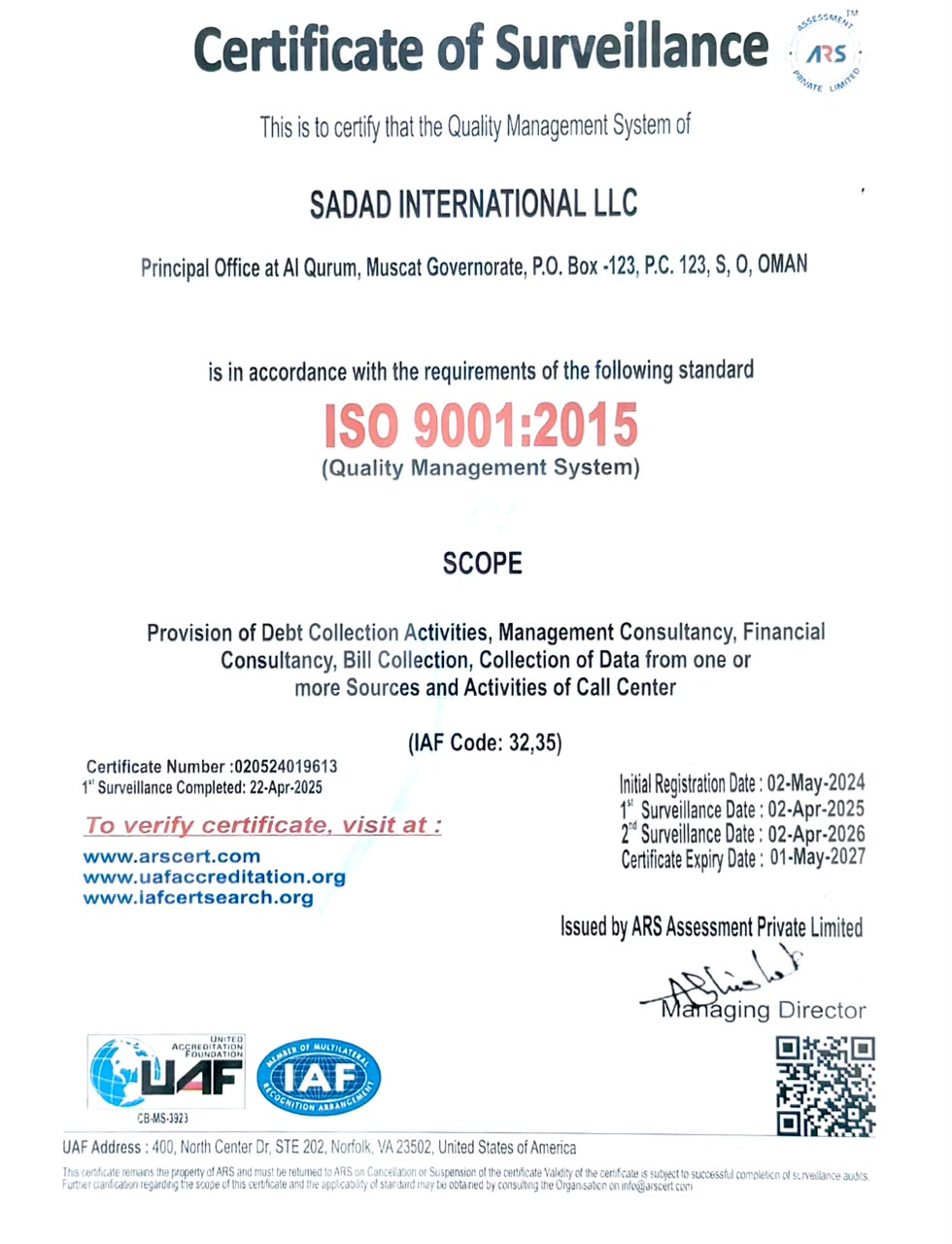
Sadad LLC provides cross-border debt recovery across the UAE, Saudi Arabia, and Oman, managing the full recovery process from multilingual amicable contact through legal escalation in each market's court system, under one ISO 9001:2015-certified, Bahwan Group-backed partner since 2005. For UAE businesses with overdue accounts in Saudi Arabia or Oman, and for international businesses recovering from UAE-based debtors, Sadad provides the local legal expertise, multilingual team, and GCC-wide court experience to recover what is owed.
For more on the legal framework, see our complete guide to UAE debt recovery laws, our step-by-step guide to legal collections in the UAE, and our bounced cheque recovery UAE guide. Or contact our UAE team today to discuss your cross-border recovery case.
This article is provided for general informational purposes only and does not constitute legal advice. Consult a licensed UAE lawyer for guidance specific to your situation and jurisdiction.
.avif)
Comments
No comments yet. Be the first to comment.
Leave a Comment