
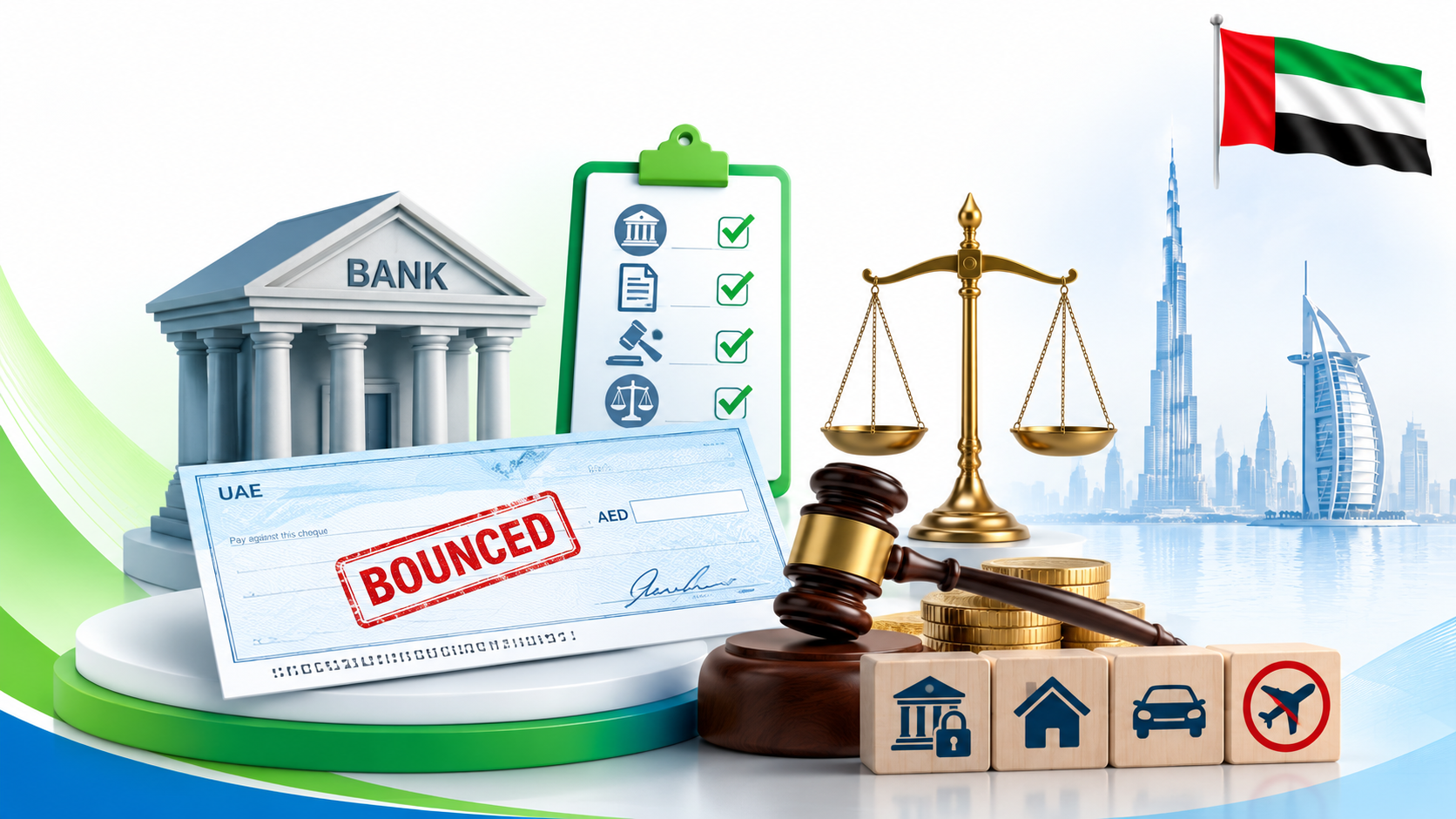
In the UAE, cheques remain one of the primary instruments for securing business transactions, and a bounced cheque gives creditors considerably more power than most businesses realise. Following landmark legal reforms under the Commercial Transactions Law (Federal Decree-Law No. 50 of 2022), the bounced cheque recovery process in the UAE has shifted dramatically: what was once a slow, uncertain civil claim is now one of the fastest enforcement routes available to creditors in the country.
This guide covers every step of the cheque bounce recovery process in the UAE, from obtaining the return memo at your bank through to Execution Court enforcement, including the specific timelines, the partial payment mechanism most creditors don't know about, and the enforcement measures available once you have a writ of execution.
The Legal Reality of Bounced Cheques as Executive Deeds in UAE 2026
Under the Commercial Transactions Law (Federal Decree-Law No. 50 of 2022), a cheque returned for insufficient funds is no longer an automatic criminal offence. Instead, the law has elevated a bounced cheque to the status of an executive deed, giving it the same legal weight as a final court judgment without requiring a full trial to establish that.
This is the most important change in the UAE bounced cheque law in 2026 for business creditors: you no longer need to sue to prove the debt. The cheque itself, combined with the bank's certificate of non-payment, is sufficient to go directly to the Execution Court and begin enforcement proceedings, bypassing the standard civil litigation track entirely.
Criminal liability under the UAE cheque decriminalisation reforms now applies only in cases of deliberate fraud, intentionally closing the account before the cheque is cashed, ordering the bank not to pay without a legitimate reason, or forging a signature. For standard insufficient-funds cases without evidence of fraudulent intent, the matter is now fully civil.
Step 1: Obtain the Return Memo from Your Bank
When the bank refuses payment on a cheque, your immediate priority is to request a formal Return Memo, also called a Certificate of Non-Payment. This document formally records the reason the cheque was dishonoured (typically "insufficient funds") and serves as the foundation for your entire bounced cheque recovery process in the UAE.
The timing requirement here is critical: you must obtain the Return Memo within six months of the cheque's issue date. Missing this window does not eliminate your civil claim, but it removes the fast-track executive deed route and forces you into standard civil litigation, which is significantly slower and more expensive. Do not delay requesting this document once a cheque is returned.
Step 2: Request Partial Payment if the Account Has Funds
This is the step most creditors miss, and it can meaningfully improve your recovery outcome. Under the Commercial Transactions Law, if the debtor's bank account contains some funds but not enough to cover the full cheque value, the bank is legally obligated to offer partial payment up to the available balance.
Critically, accepting this partial payment does not waive your right to the remaining balance. The bank will issue a separate Return Memo for the unpaid portion, which carries the same executive deed status as the original cheque, meaning you can pursue both amounts through the Execution Court simultaneously or sequentially. Always ask your bank about partial payment before proceeding to court, as it reduces the outstanding amount you need to enforce and demonstrates a good-faith recovery effort.
Step 3: File Directly with the Execution Court
Because a bounced cheque is an executive deed, you do not need to file a standard lawsuit or go through a civil trial to prove the debt. Take the original cheque and the bank's Return Memo directly to the Execution Court and file an execution application. This is the core advantage of the UAE bounced cheque recovery framework: the fast-track route that skips the standard months-long litigation process.
Your execution application should include the original bounced cheque, the bank's certificate of non-payment, any partial payment certificate if applicable, and proof of your identity and authority to file. In the UAE, this application can be filed electronically through the relevant court system depending on the emirate. A specialist debt collection agency or legal counsel can file and manage this process on your behalf, which is particularly valuable if the debtor is likely to attempt to move or hide assets once they become aware that enforcement proceedings have begun.
Step 4: Enforcement Measures Available to Creditors
Once the Execution Court reviews and accepts the application, the judge issues a writ of execution within a matter of days. The debtor is given a short notice period, typically five days, to settle voluntarily. If they fail to pay within that window, the court can immediately enforce a range of measures against the debtor without further hearings.
Enforcement measures available for bounced cheque recovery in the UAE include freezing all corporate and personal bank accounts, seizing and selling movable assets, real estate, and vehicles, and imposing a travel ban on the signatory of the cheque — preventing them from leaving the UAE until the debt is satisfied. The combination of account freezing and travel ban is often sufficient to prompt immediate voluntary settlement, since the practical consequences for the debtor are severe and immediate.
Speed matters significantly at this stage. Filing promptly after receiving the Return Memo reduces the risk that the debtor has time to move funds, transfer assets, or otherwise reduce the pool of recoverable assets before enforcement reaches them. Engaging a specialist debt collection agency in the UAE immediately after a cheque bounces, rather than after informal follow-up has failed, typically produces faster and higher recovery outcomes.
This article reflects the general UAE legal framework as understood at the time of writing and is provided for general informational purposes only. It does not constitute legal advice; consult a licensed UAE lawyer for guidance specific to your situation.
.avif)
Comments
No comments yet. Be the first to comment.
Leave a Comment