

Credit Evaluation for SMEs in Oman: How to Prevent Bad Debt and Manage Receivables
For a large corporation, one bad debt is a manageable setback. For an Omani SME, one significant bad debt can threaten payroll, supplier relationships, or the business itself. That asymmetry is exactly why credit evaluation for SMEs in Oman deserves more attention than it typically gets and why SMEs that build even a basic screening habit tend to be dramatically more resilient than those extending credit purely on relationship and instinct.
The reassuring part: proper receivables management for SMEs in Oman doesn't require a dedicated risk department. It requires a consistent, repeatable process genuinely achievable for any small or growing Omani business.
Why SME Debt Collection in Oman Is a Different Problem
SME debt collection in Oman carries a specific challenge larger companies don't face in the same way: concentration risk. A large enterprise typically has receivables spread across hundreds of accounts, so one non-payer barely dents the total. A growing Omani SME might have receivables concentrated in five, ten, or twenty relationships, meaning a single serious payment default can represent a meaningful share of total outstanding cash.
This is exactly why bad debt prevention for SMEs in Oman matters disproportionately more here than for large corporates: the cost of a rigorous Mala'a credit check upfront is small; the cost of a bad debt write-off, on thin SME margins, can be existential. The arithmetic is simple and consistent: prevention almost always costs less than recovery, and recovery almost always costs less than write-off.
Unpaid Invoices for Small Businesses in Oman: The Compounding Effect
For a small business, unpaid invoices in Oman don't just sit as a line item; they compound. Cash that should be funding next month's payroll or inventory is instead tied up in a customer's accounts payable. Because SMEs typically have less financial buffer than larger companies, the practical impact of a single large overdue invoice shows up faster and more painfully, sometimes within weeks rather than quarters.
The compounding dimension also applies to the recovery process itself. An invoice at 30 days overdue has strong recoverability. The same invoice at 150 days, after months of ignored follow-up, no formal demand, and no specialist escalation, has materially diminished prospects. The overdue payment recovery process for SMEs in Oman is time-sensitive in a way that corporate receivables management often isn't, because the buffers are smaller and the options narrow faster.
How to Check Customer Payment Risk in Oman: A Four-Step Process
Step 1: Commercial Registration Verification
Every legitimate Omani business operates under a Commercial Registration issued through the Ministry of Commerce, Industry and Investment Promotion. Verifying it confirms the entity legally exists, is active, and matches the name actually signing your contract a basic step that prevents an entire category of confusion and risk. A customer who cannot or will not provide their CR number before signing a credit agreement is a risk signal in itself.
Step 2: A Mala'a Credit Report
Mala'a, the Oman Credit and Financial Information Centre, established by Royal Decree 38/2019 under the supervision of the Central Bank of Oman, is the national credit bureau covering both individuals and corporates. A Mala'a credit report on a prospective business customer shows registered credit facilities and repayment history over roughly the preceding 24 months, along with bounced cheque records and disputes, a strong, independently verified signal before extending trade credit in Oman. It should be treated as the essential first screening layer for any new customer relationship, regardless of how well you feel you know them from the sales process.
Step 3: Trade Reference and Payment Behaviour Checks
Speaking directly with a prospective customer's other suppliers, where feasible, often reveals payment behaviour a credit bureau report alone doesn't capture, particularly around informal trade credit that isn't centrally reported to Mala'a. For higher-value relationships where the credit exposure justifies extra diligence, trade references are the most reliable supplement to a Mala'a report for assessing how a customer actually treats their suppliers in practice.
Step 4: Sector-Informed Risk Context
The same credit profile can carry different risk depending on sector. A contractor with milestone-based project revenue carries different structural risk than a retail distributor with steady daily sales, even with a similar Mala'a history. Factoring in typical payment cycles for the customer's sector is part of a genuinely useful trade credit management approach for Omani SMEs and is one of the capabilities a specialist credit evaluation service provides that a simple bureau check alone cannot.
Business Credit Assessment for Omani SMEs: A Practical Framework
Once the information is gathered, the decision on how much credit to extend and on what terms matters as much as the research itself. The principles for business credit assessment in Oman at SME scale are consistent regardless of industry:
- Start conservative with new relationships. A modest initial credit limit, reviewed upward after a track record of on-time payment across several billing cycles, protects downside without blocking the relationship from growing.
- Size exposure to your own cash flow tolerance, not just the customer's apparent scale. A large customer with a large potential order isn't automatically a risk you can absorb; size it to what your business can withstand if payment is delayed by 60 or 90 days.
- Review limits at renewal. Real payment behaviour after several billing cycles is far more predictive than the original credit check. Credit limit management in Oman is an ongoing discipline, not a one-time onboarding step.
- Document your credit policy, even informally. Written credit criteria, even a one-page internal document, means credit decisions aren't made ad hoc under sales pressure. This is one of the most common sources of avoidable bad debt for SMEs in Oman.
Overdue Payment Recovery for SMEs in Oman: When It Still Happens
Even with careful credit evaluation for SMEs in Oman, some accounts will go overdue; that's a normal part of running a business that extends trade credit. What separates SMEs that recover well from those that don't is having a defined process ready before it's needed: structured amicable follow-up first, a clear escalation timeline (typically 60–90 days), and a specialist SME debt collection partner in Oman engaged before the debt ages to the point where recoverability has meaningfully declined.
The most consistent mistake growing Omani SMEs make in overdue payment recovery is waiting too long to escalate, typically out of reluctance to damage the customer relationship. A specialist collection partner preserves the relationship more effectively than internal follow-up, because the collections role is kept separate from the sales role. The customer knows the escalation is procedural, not personal.
Cash Flow for Small Businesses in Oman: Why Prevention Beats Recovery
Every Omani rial spent on proper credit evaluation for SMEs upfront is typically far cheaper than the same amount spent trying to recover a bad debt after the fact and dramatically cheaper than the amount lost outright when recovery fails. For cash flow management for small businesses in Oman specifically, this isn't just a cost-efficiency argument; it's often the difference between steady, predictable operations and a genuine liquidity scare triggered by one or two large customer defaults.
Bad Debt Prevention Checklist for Omani SMEs
- Verify Commercial Registration before signing any new account
- Pull a Mala'a credit report as a baseline screen on every new customer
- Cross-check trade references where the deal size justifies extra diligence
- Set an initial credit limit conservatively and review it at renewal
- Track receivables ageing weekly, not monthly
- Escalate overdue accounts on a defined timeline; do not let them drift past 90 days
Sadad's Credit Evaluation Service for Omani SMEs
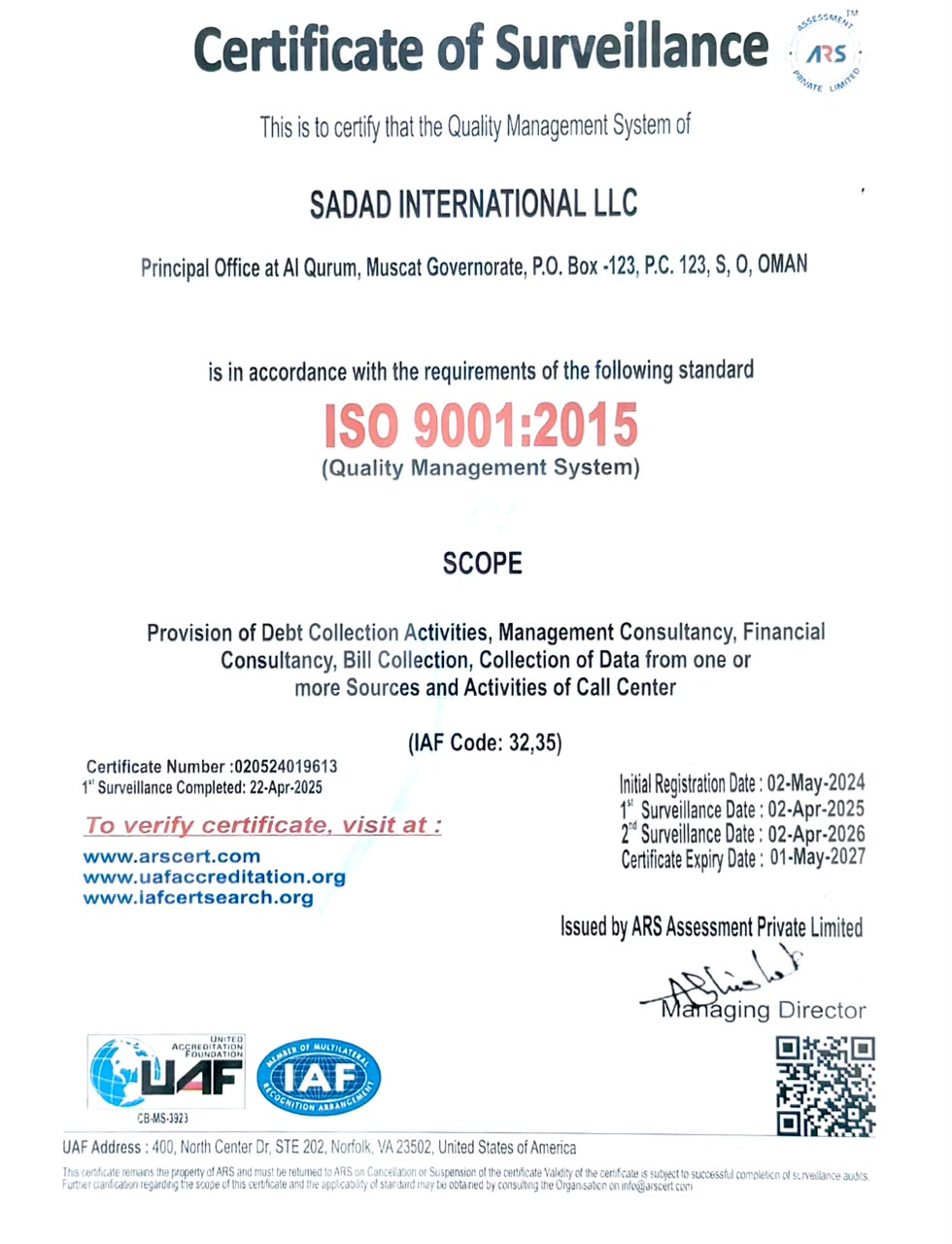
Sadad LLC's credit evaluation service is built for businesses that don't have an in-house credit risk team but still need reliable, fast customer screening before extending terms. For the broader picture of proactive versus reactive debt management, see our guide to proactive vs reactive debt management in Oman, 5 signs your business in Oman needs debt collection services, or contact our Muscat team to set up a screening process for new customers.
This article is provided for general informational purposes and does not constitute financial or legal advice.
.avif)
Comments
No comments yet. Be the first to comment.
Leave a Comment