

Most businesses in Oman don't bring in professional debt collection services until well past the point at which it would have helped most. It usually follows months of a slow drift: DSO creeping upward, a finance team spending more time chasing payments than closing the books, and eventually a bad debt write-off that stings more than it should have. The businesses that act on the warning signs early recover more and spend far less doing it than those that wait for a crisis. Here are the five signs worth taking seriously.
Sign 1: DSO Has Been Rising for Two or More Consecutive Quarters in Oman
A single slow month is noise. A sustained rise in Days Sales Outstanding across two or more consecutive quarters is a signal. It usually points to one of three underlying issues: credit terms have drifted looser than intended, the customer base has shifted toward slower payers, or internal follow-up simply hasn't kept pace with growing invoice volume. Whatever the cause, DSO reduction in Oman moving in the wrong direction for a sustained period is one of the earliest, clearest indicators that receivables need dedicated attention, often before the cash flow impact is obvious anywhere else.
The risk in waiting is that a rising DSO compounds. Each month, if it isn't addressed, the oldest invoices on the ageing report age further and lose recoverability, while newer invoices are already being issued on the same loose terms, adding to the problem. Specialist receivables management services in Oman are specifically designed to interrupt this pattern before it becomes structural.
Sign 2: Overdue Payments Past 90 Days Are Routine, Not Exceptional, in Oman
Every business has the occasional invoice that drifts past 90 days for a legitimate, one-off reason. What's different, and what points to a structural problem rather than a one-off, is when overdue payments in Oman past 90 days become a recurring category on the ageing report, rather than an exception worth investigating individually.
Unpaid invoices in Oman lose recoverability the longer they age. A debt fresh at 30 days is a fundamentally different recovery prospect than the same debt at 150 days, after months of ignored follow-up. The moment 90+ day overdue becomes a routine line item rather than a named exception, professional debt collection services in Oman become a financial priority rather than a last resort.
Sign 3: Late Payment Challenges Are Consuming Internal Team Time in Oman
This sign is easy to feel and hard to quantify. If your finance team or even the business owner directly is regularly making follow-up calls, sending "just checking in" emails, or manually tracking who still owes money in a spreadsheet, that's real time pulled away from growth and actual finance work.
These late payment challenges in Oman cost more than the missing cash itself; they cost the hours spent chasing it. Hours that specialist receivables management services exist specifically to absorb, consistently and professionally, without the awkwardness of having the same person who manages the sales relationship also chase the overdue invoice. The outsourced receivables model keeps the two roles cleanly separated, protecting both the commercial relationship and the collection outcome.
Sign 4: Credit Risk Warning Signs Are Clustering Across Multiple Accounts
Individually, a single late payment might mean nothing. But watch for patterns forming across the customer base at once. The credit risk warning signs that matter most in combination are: several customers requesting extended terms or partial payments around the same period; a rise in disputed invoices or requests for reissued documentation; previously reliable payers suddenly slipping into late payment without explanation; and new customers onboarded without a proper Mala'a credit check now showing early payment trouble.
When these credit risk warning signs in Oman cluster together across multiple accounts simultaneously, it's a signal that credit assessment informed by a proper Mala'a credit report from Oman's national credit bureau, not just a collections effort, needs to tighten. Our guide on proactive vs reactive debt management in Oman covers how to build that assessment step properly before the problem compounds.
Sign 5: A Bad Debt Write-Off Has Already Happened at Least Once in Oman
A confirmed bad debt recovery in Oman, when an invoice is written off as genuinely uncollectable, is more expensive than it looks on the surface. A bad debt write-off doesn't just cost the invoice amount; at typical net margins, replacing that lost profit requires considerably more in new revenue. One write-off might be an isolated bad break. A second one, particularly from a customer that wasn't properly credit-checked when onboarded, is a process gap worth closing before it happens a third time.
The consistent pattern behind most avoidable bad debt in Oman is a credit decision made without adequate upfront assessment, followed by a collections process that escalated too late. Proactive debt collection services in Oman, combined with structured credit evaluation before terms are ever extended, address both sides of that pattern at once.
A Quick Self-Check for Business Financial Health in Oman
If two or more of the following are true right now, it's a strong signal to bring in professional support rather than continuing to manage collections internally:
1. DSO has trended upward for two or more consecutive quarters
2. 90+ day overdue invoices are a routine line item, not a rare exception
3. Internal staff time spent on chasing payments has visibly increased
4. Multiple customers are showing credit risk warning signs at once
5. You've had a confirmed bad debt write-off in the past 12 months
What Receivables Management Services in Oman Actually Deliver
The value of professional receivables management services in Oman isn't simply "more people making calls." It's a few specific capabilities that are genuinely hard to build internally at small-to-mid scale: credit intelligence on customers before terms are extended not just collections effort after the fact; a consistent escalation framework applied the same way every time rather than depending on whoever happens to make the call that day; local knowledge of Oman's court system for the minority of cases that need legal escalation; and a collections identity kept separate from the sales relationship, so account managers aren't put in the awkward position of chasing customers they also need to sell to next quarter.
For businesses weighing whether to outsource receivables management in Oman or continue handling collections internally, the honest calculation usually comes down to one question: is the cost of the specialist lower than the value of the cash flow being freed up and the internal time being recovered? For most growing Omani businesses dealing with more than one of the five signs above, it almost always is.
Talk to Sadad Before a Small Problem Becomes a Bigger One
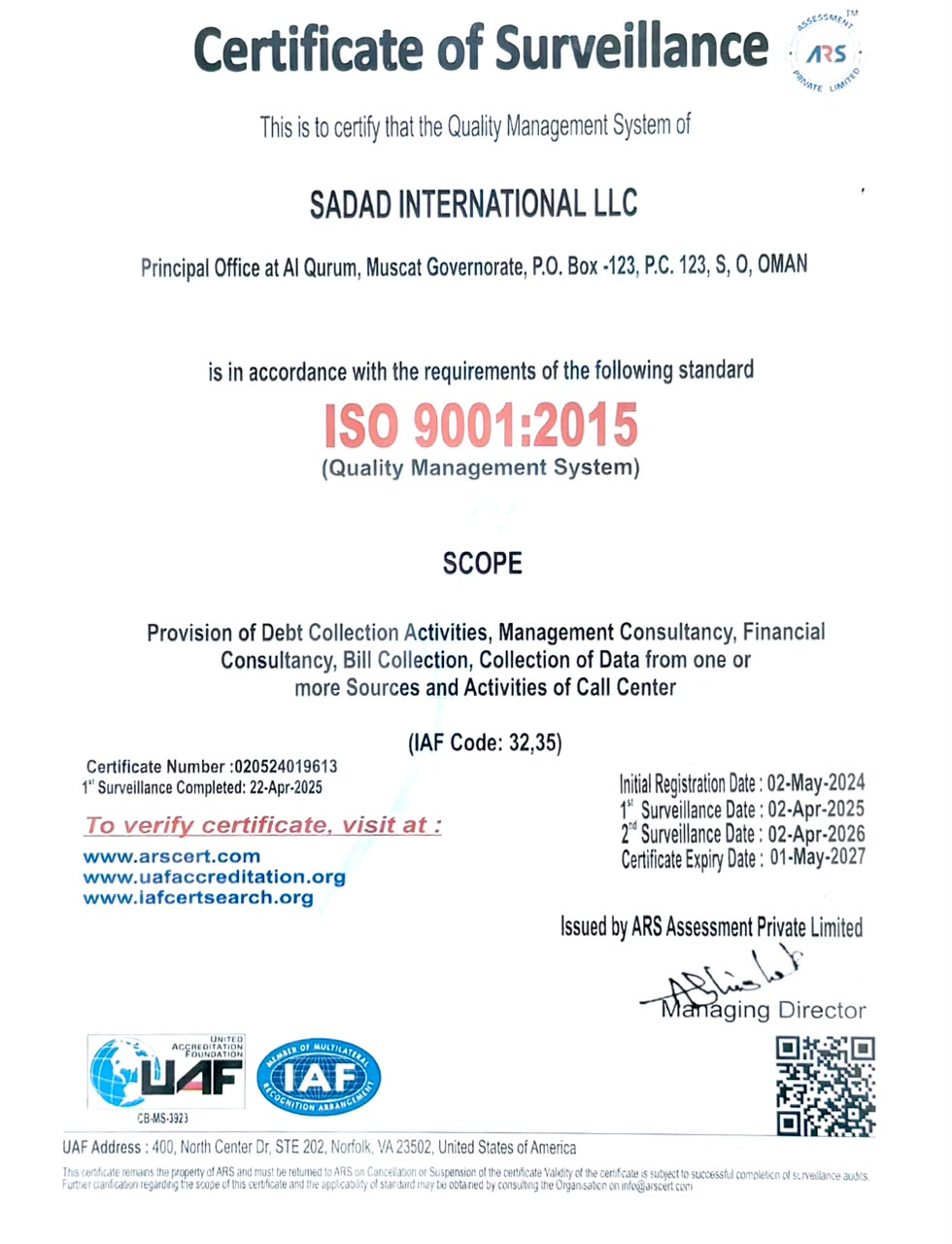
Sadad LLC offers combined receivables management and debt collection services across Oman, built to catch these warning signs early rather than only stepping in once an account is already a lost cause. For the practical path once you do need to act, see how to recover unpaid invoices in Oman, or contact our Muscat team for a review of your receivables position.
This article is provided for general informational purposes and does not constitute legal or financial advice.
.avif)
Comments
No comments yet. Be the first to comment.
Leave a Comment