

An unpaid commercial debt in Oman moves through a structured sequence, and understanding that sequence, rather than reacting instinctively at each stage, is what separates businesses that recover efficiently from those that escalate too fast or wait too long. This debt recovery guide for Oman covers the full debt collection process Oman businesses should follow, including a genuinely significant and recent legal development: Oman's new Investment and Trade Court, in force since 1 October 2025.
Stage 1: Amicable Debt Recovery in Oman
The large majority of overdue commercial debts in Oman are resolved here, without ever reaching a courtroom. Amicable debt recovery in Oman begins with an assessment of the debtor's solvency, sector, business history, and the strength of available documentation; this shapes the strategy. Structured contact begins immediately once an account becomes past due: phone, email, and formal written notice, aimed at reaching a payment agreement or settlement.
Cultural context matters here more than in many jurisdictions. Omani business culture places real weight on relationships and reputation, and respectful, persistent, professional communication tends to produce better outcomes than aggressive early escalation. Most non-payment in Oman reflects the debtor's own cash flow pressure, not a refusal to pay.
Stage 2: Formal Demand Letter in Oman
If amicable contact doesn't resolve the matter, the next step is a formal demand letter in Oman, a written notice, typically issued through a collections specialist or lawyer, stating the debt, the amount owed, and a clear deadline before further action follows. This step matters beyond persuasion: it forms part of the documented record of good-faith resolution attempts that Omani courts generally expect to see before a case proceeds to litigation.
Stage 3: Commercial Court Debt Recovery Oman: The Investment and Trade Court
This is where Oman's legal landscape has changed substantially and recently. As of 1 October 2025, the Investment and Trade Court, established by Sultani Decree No. 35/2025, issued on 23 March 2025 and published in the Official Gazette on 6 April 2025, is now the specialist forum for commercial court debt recovery in Oman, replacing the previous Commercial Court structure for matters within its jurisdiction.
Key features businesses should understand before filing:
Exclusive jurisdiction over commercial disputes: the Court has authority wherever at least one party is a merchant and the dispute relates to commercial business, along with investment contract disputes.
Broad subject-matter coverage: including shareholder and partner disputes, commercial asset matters, banking, securities, insurance, insolvency and restructuring, arbitration-related applications, and electronic commercial transactions.
Fully electronic procedure: all filings and notifications happen through a mandatory digital platform, with a Case Preparation Office reviewing completeness within three working days of electronic registration.
Defined response timelines: the defendant has 15 days to respond electronically once notified; the plaintiff then has 15 days to comment a marked improvement in predictability over the previous system.
Deemed service through official registers: notification to the address recorded in the commercial register is treated as valid service, reducing a historically common source of delay.
Cases filed before 1 October 2025 continue under the previous court structure. Businesses with pending matters should confirm which framework applies.
For claims outside the new Court's exclusive jurisdiction, Oman's general Civil and Commercial Procedures Law (Royal Decree 29/2002) continues to govern procedure, including a well-established payment order route for clear-cut claims, where the court issues a payment order in Oman within roughly three days for straightforward cases. The debtor has 15 days to formally contest; without a substantiated complaint, the order becomes a final, enforceable judgment.
Stage 4: Judgment Enforcement in Oman
Winning a judgment establishes that a debt is owed; it doesn't, by itself, recover the money. Under the Investment and Trade Court framework, judgment enforcement in Oman is treated as a distinct judicial service, overseen by a dedicated enforcement judge who supervises execution and resolves disputes arising during it. Challenges to enforcement decisions go to the Court's own appeal circuits and are final at that level, a faster path than routing enforcement disputes through the general appellate system.
The process is now digitised end to end: debtors can view enforcement requests electronically, see exactly what's owed, and pay directly through the same platform. Once a judgment is satisfied in full, the system automatically cancels all orders and decisions issued against the debtor. Where a debtor doesn't comply voluntarily, enforcement measures can include freezing and seizing bank account funds, seizing and selling movable or immovable property, and seizing securities or company shares, with proceeds applied to satisfy the debt.
Stage 5: Bankruptcy as an Alternative Asset Recovery Route in Oman
For debtors that have genuinely stopped paying, Oman's Bankruptcy Law (Royal Decree 53/2019) provides a separate avenue. A creditor with an undisputed commercial debt that has become due and payable can petition to have the debtor declared bankrupt if the debtor has stopped paying debts as they fall due. This route is also available where a debtor has no known place of residence in Oman, is evading contact, has closed or begun winding down its business, or has taken actions detrimental to creditors. Asset recovery in Oman through bankruptcy proceedings is more complex than standard enforcement and is typically pursued where a debtor's conduct suggests ordinary enforcement won't be effective.
Appeals and Timelines
Under Oman's general procedural framework, a judgment from a court of first instance can be appealed to the Court of Appeal within 30 days of notification; a Court of Appeal judgment can be further appealed to the Supreme Court within 40 days. Filing an appeal does not automatically stay execution; a stay must be specifically requested and is granted only where continued execution would cause significant, irreparable harm. The Supreme Court's judgment is final.
GCC Cross-Border Debt Recovery Considerations in Oman
For creditors pursuing debtors across GCC borders, foreign judgment enforcement in Oman depends on reciprocity; the country where the judgment was issued must itself enforce Omani judgments under comparable conditions. Oman is party to the 1995 GCC Protocol relating to the enforcement of judgments among member states, which provides a smoother path for GCC-originating judgments than for fully foreign judgments. As of 2025, applications to enforce a foreign judgment in Oman are filed before the Investment and Trade Court, and any foreign-language judgment must be accompanied by a certified Arabic translation.
Steps to Recover a Commercial Debt in Oman Checklist
1. Confirm the debt is accurately documented in the contract, invoices, delivery and acceptance evidence, and correspondence.
2. Begin structured amicable collection in Oman promptly once the account passes due.
3. Escalate to a formal demand letter if amicable efforts stall.
4. Consider whether the claim qualifies for the expedited payment order route.
5. If litigation is necessary, confirm whether the Investment and Trade Court or the prior framework applies to your case.
6. Move promptly to enforcement in Oman once judgment is obtained.
7. For debtors showing signs of insolvency or evasion, evaluate whether bankruptcy proceedings under Royal Decree 53/2019 are the more effective route.
How Sadad Manages This Full Escalation Path
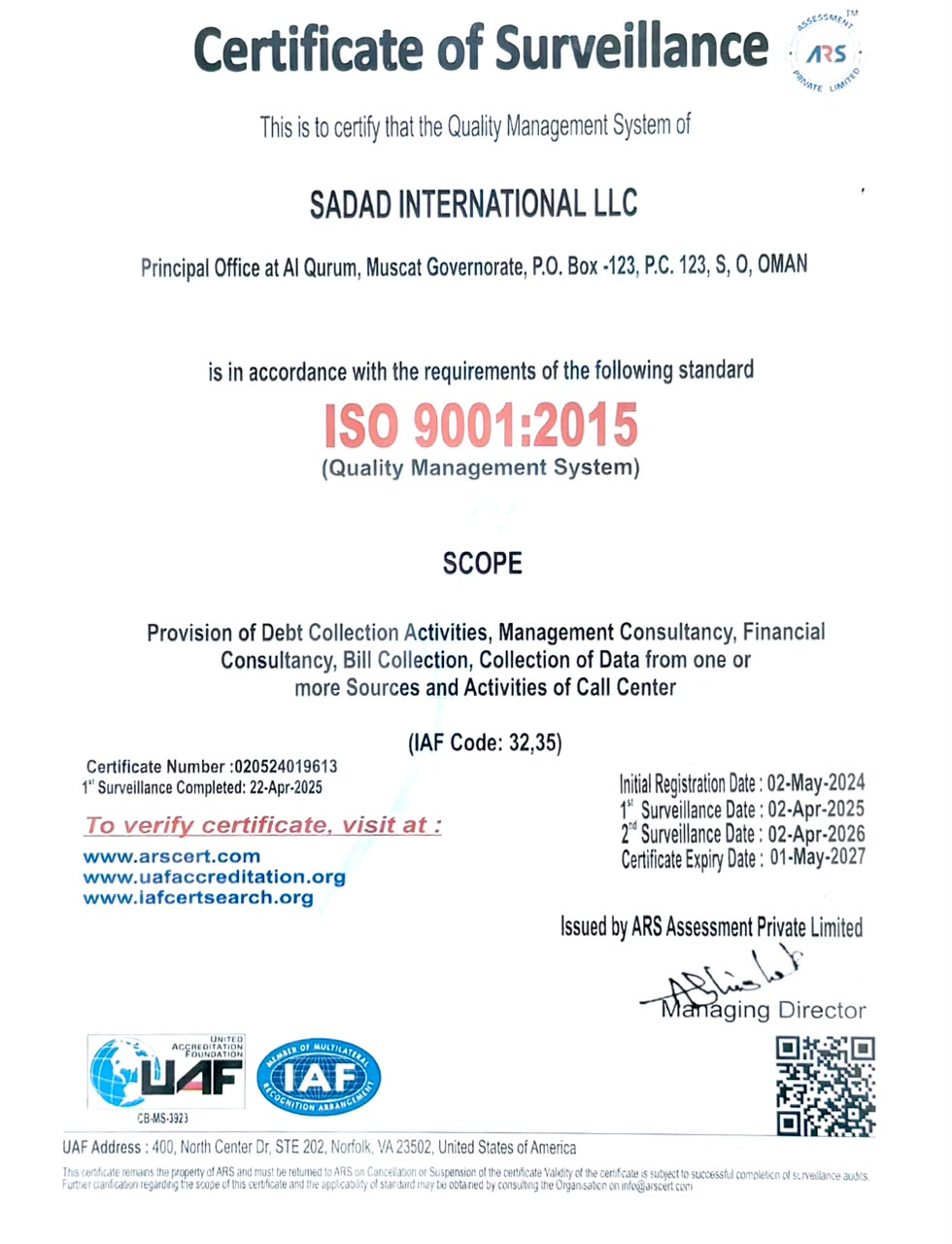
Sadad LLC's debt collection and legal collections services in Oman follow exactly this sequence, so clients get a consistent, professionally managed debt recovery process rather than having to coordinate each stage themselves. For a deeper look at the legal framework, see our guide on understanding Omani commercial law for debt recovery, our overview of protecting business cash flow in Oman, or contact our Muscat team directly.
This article reflects the general legal framework as understood at the time of writing, including the Investment and Trade Court reforms in force since October 2025. It is provided for general informational purposes only and does not constitute legal advice; consult a licensed Omani lawyer for guidance on a specific matter.
.avif)
Comments
No comments yet. Be the first to comment.
Leave a Comment