

What do businesses need to know about legal debt recovery in Saudi Arabia?
Legal debt recovery in Saudi Arabia uses two courts: the Saudi Commercial Court (which issues the enforceable judgment) and the Saudi Enforcement Court (which executes it via the Najiz platform). Before filing, a formal Arabic demand letter with proof of delivery is mandatory. The Saudi Enforcement Law provides powerful execution tools: bank account freezes, asset attachment, travel restrictions, and business activity restrictions. SIMAH data before filing reveals the debtor's asset position and informs enforcement strategy.
Key Takeaways
- Two courts handle legal debt recovery in Saudi Arabia: the Commercial Court (judgment) and the Enforcement Court (execution).
- A formal Arabic demand letter with proof of delivery is a mandatory prerequisite before court filing.
- All court documents must be in Arabic — certified translations required for English-language contracts and invoices.
- The Saudi Enforcement Law provides bank account freezes, asset attachment, travel restrictions, and business restrictions.
- The Najiz digital platform is the primary gateway for Enforcement Court filings in Saudi Arabia.
- SIMAH data before filing reveals the debtor's asset position and informs enforcement strategy.
Who This Guide Is For?
This guide is for business owners, finance directors, CFOs, and legal counsel in Saudi Arabia and for international businesses with debtors in the Kingdom who need a practical understanding of the legal debt recovery framework, the court process, and enforcement tools available. It is designed to provide practical clarity, not a substitute for legal advice.What Is Legal Debt Recovery in Saudi Arabia?
Legal debt recovery in Saudi Arabia is the court-based process of recovering outstanding commercial debts using the Saudi Commercial Court to obtain an enforceable judgment, and the Saudi Enforcement Court (accessed via the Najiz digital platform, najiz.sa) to execute it. SIMAH (Saudi Credit Bureau, regulated by SAMA) data identifies debtor assets before enforcement action begins. ZATCA-compliant e-invoices are the strongest form of documentary evidence for Saudi Commercial Court claims, digitally authenticated and harder to dispute than paper invoices. A professional debt recovery agency in Saudi Arabia manages the full process from formal demand through to asset enforcement within a single service relationship. Learn about Sadad LLC's legal collections service →Warning Signs That Legal Action Is Required
Escalate to Legal: Saudi Arabia Debtor Risk Signals
- A SIMAH monitoring alert shows new Enforcement Court proceedings filed by another creditor against the debtor; your window for enforcement is narrowing.
- The debtor's Commercial Registration (CR) status changes or lapses, a possible business wind-down before asset dissipation.
- The debtor issues ZATCA-non-compliant invoices or fails to issue invoices for amounts owed, indicating financial system stress.
- The debtor makes partial payment well below the invoiced amount without prior agreement, suggesting inability to pay in full.
- The debtor becomes unreachable within 30 days of the invoice due date, and formal demand produces no response within the 7–14 day deadline.
The Legal Framework for Debt Recovery in Saudi Arabia
Law 1:Saudi Commercial Courts Law
Governs jurisdiction over commercial disputes between merchants, unpaid invoices, contract payment disputes, bounced cheques, and B2B commercial obligations. For well-documented claims, the Commercial Court can issue a payment order without a full hearing, significantly accelerating the timeline to an enforceable judgment.
Law 2:Saudi Enforcement Law
Governs execution of court judgments. Provides the legal basis for the Enforcement Court's powers: bank account freeze orders; asset attachment; travel restrictions; business activity restrictions; and wage attachment for individual debtors or guarantors.
Prerequisites Before Filing a Legal Debt Recovery Claim
- Formal Arabic demand letter: Written in Arabic, sent to the debtor's registered CR address via trackable delivery, with a 7–14-day payment deadline, stating imminent Commercial Court proceedings. Mandatory prerequisite: The court requires evidence that it was sent and received.
- Complete Arabic-language documentation: Contract, invoices (ZATCA-compliant preferred), delivery confirmation, payment records, correspondence, all in Arabic or with certified translations.
- CR verification: Confirm the debtor's CR name, registration number, and registered address to ensure the filing is directed to the correct legal entity.
Recovery Route Comparison: Legal Debt Recovery in Saudi Arabia
| Route | Best For | Timeline | Cost | Outcome |
| Payment order (undisputed) | Clear, well-documented claims; debtor unlikely to object | 3–8 weeks | Low court fee | Enforceable judgment without hearing |
| Contested hearing (straightforward) | Debtor raises defence, but documentation is strong | 12–20 weeks | Court fee + contingency | Judgment after hearing |
| Contested hearing (complex) | Counter-claims, expert witnesses, multi-party disputes | 20–36 weeks | Higher expert costs | Judgment after full proceedings |
| Enforcement Court (post-judgment) | Debtor does not comply voluntarily after judgment | 4–16 weeks | Disbursements at cost | Bank freeze, asset attachment, travel ban |
The Saudi Commercial Court Process
Payment Order Mechanism
For clear, well-documented commercial debt claims where the debt is undisputed and documentation is complete, the Commercial Court issues an expedited payment order without requiring a full hearing. The debtor is notified and has a defined period to raise a substantiated objection. Without a valid objection, the payment order becomes a final, enforceable judgment typically within 3–8 weeks of filing.
Contested Proceedings
Where the debtor raises a defence, contract dispute, quality objection, or counter-claim, the matter proceeds to a full hearing. Professional debt recovery companies prepare cases to withstand debtor defences, anticipating likely objections and ensuring documentation thoroughly supports the claim. Sadad LLC legal collections service →
The Saudi Enforcement Court and Najiz Platform
After obtaining a Commercial Court judgment, the creditor files for enforcement through the Saudi Enforcement Court accessed via the Najiz platform (najiz.sa), the Ministry of Justice's digital enforcement gateway. The Enforcement Court assigns an enforcement judge who supervises execution and has authority to issue all enforcement orders.
Enforcement Tools: Saudi Enforcement Law
- Bank account freeze: The enforcement judge orders Saudi banks to freeze the debtor's accounts, preventing withdrawal or transfer until the judgment is satisfied.
- Asset attachment: Property, vehicles, equipment, and securities identified using SIMAH data and official registries are attached pending sale to satisfy the judgment.
- Travel restrictions: The debtor's principals are prevented from leaving Saudi Arabia, creating significant personal pressure to resolve the judgment.
- Business activity restrictions: The enforcement judge restricts the debtor's ability to conduct commercial activity until the judgment is satisfied.
- Wage attachment: For individual debtors or guarantors, a portion of salary is attached to satisfy the judgment over time.
GCC Cross-Border Debt Recovery from Saudi Arabia
Saudi creditors pursuing debtors with assets in the UAE or Oman and international creditors with Saudi debtors, can use the Riyadh Arab Convention on Judicial Cooperation and the 1995 GCC Protocol to recognise and enforce Saudi judgments in other GCC member states. A single GCC-wide debt recovery agency manages this process without separate provider engagement in each market. Learn about GCC cross-border recovery →
Ready to Begin Your Saudi Arabia Legal Recovery?
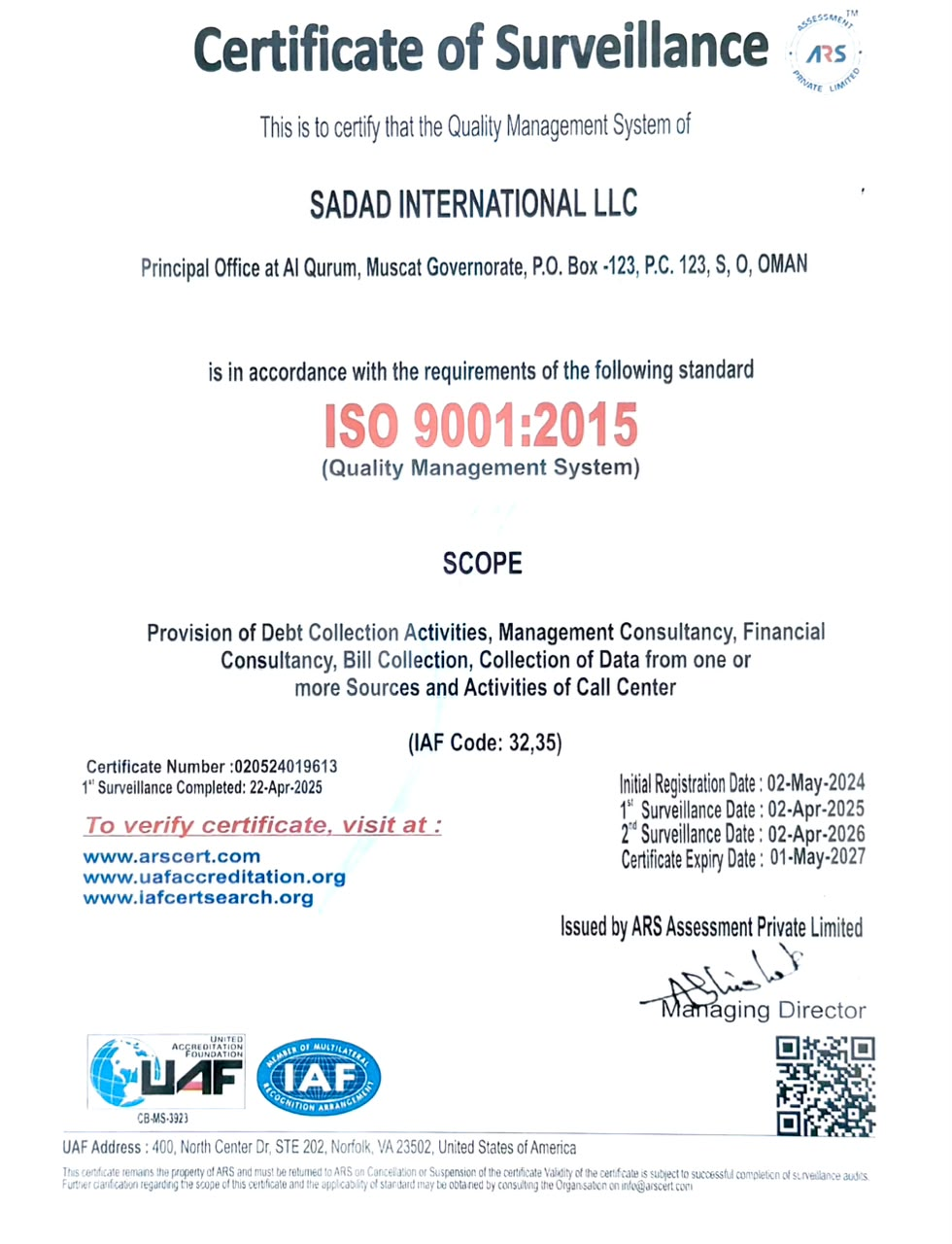
Sadad LLC provides legal debt recovery and full-cycle credit management across Saudi Arabia, UAE, and Oman. ISO 9001:2015. Bahwan Group. Contact our legal collections team today →
This article is for general informational purposes only and does not constitute legal or financial advice.
.avif)
Comments
No comments yet. Be the first to comment.
Leave a Comment