

How can SMEs in Saudi Arabia avoid bad debt through credit evaluation?
Credit evaluation for SMEs in Saudi Arabia requires four practical actions: conducting a SIMAH credit check on every new customer before extending trade credit; verifying the customer's Commercial Registration (CR) on the Maroof platform; setting and enforcing credit limits based on the SIMAH assessment; and implementing a structured invoice follow-up programme with automatic handover to professional debt collection at 60 days overdue. These four actions, applied consistently, prevent the majority of bad debts that Saudi SMEs currently write off.
Key Takeaways
- SIMAH credit checks must be a non-negotiable step in every new customer onboarding process for Saudi SMEs.
- CR verification on Maroof confirms legal existence and registered address before any credit is extended.
- Credit limits calibrated to SIMAH data prevent the single large write-off that can threaten SME viability.
- A simple three-contact follow-up programme recovers most overdue SME accounts without professional escalation.
- Outsourcing debt collection at 60 days costs less than continued in-house effort and recovers more.
- Vision 2030 SME expansion is increasing trade credit volumes and bad debt exposure for small Saudi businesses.
Who This Guide Is For
This guide is for small and medium-sized business owners, finance managers, and credit controllers in Saudi Arabia who extend trade credit to other businesses. It provides a practical, affordable framework for managing payment risk designed for businesses without dedicated credit teams, aligned with SIMAH bureau data and ZATCA invoicing requirements.
Why Bad Debt Is a Disproportionate Problem for Saudi SMEs?
Vision 2030's SME development programme through Monsha'at, SME financing programmes, and government procurement targets has significantly increased the volume of B2B trade conducted by Saudi small and medium-sized businesses. With increased trade comes increased trade credit and increased bad debt exposure.
Large Saudi businesses can absorb bad debt write-offs; they have diversified portfolios, large cash reserves, and dedicated credit teams. Saudi SMEs cannot. A single large write-off can eliminate months of profit and destabilise working capital. Yet most SMEs manage credit risk through relationship trust rather than structured credit evaluation.
What Is Credit Evaluation for Saudi SMEs?
Credit evaluation for SMEs in Saudi Arabia is the process of assessing the payment risk of a prospective customer before extending trade credit, determining how much credit to offer, on what terms, and at what monitoring frequency. For Saudi SMEs, practical credit evaluation is built on two foundations: SIMAH credit data (payment history, outstanding obligations, enforcement proceedings) regulated by SAMA (Saudi Arabian Monetary Authority); and CR verification on Maroof (legal existence, registered address, authorised signatories). Together, these two inputs enable a data-driven credit decision rather than a relationship-based guess.
How to Use SIMAH for SME Credit Evaluation in Saudi Arabia
Step 1: Make SIMAH checks mandatory
Step 2: Verify CR on Maroof
Step 3: Set a credit limit
Step 4: Calibrate payment terms to risk
Step 5: Review annually
What Does a SIMAH Report Show for a Saudi Business?
- Payment history: Record of payments made on time, late, or missed across all the business's credit relationships; the most direct indicator of future payment behaviour.
- Outstanding credit obligations: Current credit facilities, outstanding balances, and credit utilisation rate; high utilisation signals financial pressure even with a clean payment record.
- Enforcement proceedings: Any existing court judgments or enforcement orders against the business are a critical red flag for any credit decision.
- CR details: Confirmation of the business's legal registration status cross-referenced against Maroof verification.
- Recent credit inquiries: SIMAH inquiries made by other credit providers in the past 90 days. Multiple simultaneous inquiries indicate active credit-seeking, which may signal financial stress.
Simple Receivables Management Programme for Saudi SMEs
Saudi SMEs do not need complex systems; they need consistent follow-up applied to every invoice. This programme runs on a standard spreadsheet or accounting system:
- Invoice day: Issue a ZATCA-compliant e-invoice immediately on delivery. Record the due date. Send confirmation to the customer.
- 15 days before due: Automated reminder email or WhatsApp to accounts payable contact.
- 5 days after due: Telephone call to accounts payable to confirm invoice received and expected payment date.
- 15 days after due: Formal written reminder from the business owner or senior finance contact via email and letter.
- 30 days after due: Direct contact with senior management at the debtor company. Request a meeting if payment is not confirmed within 48 hours.
- 60 days after due: Refer to a professional debt collection company. Stop in-house follow-up immediately.
Credit Evaluation vs No Credit Evaluation: Outcome Comparison
| Metric | With SIMAH Credit Evaluation | Without Credit Evaluation |
| Average DSO | 35–50 days | 65–90 days |
| Bad debt write-off rate | 0.5–1.5% of revenue | 3–6% of revenue |
| Recovery rate (60-day debts) | 75–85% | 40–55% |
| Legal proceedings frequency | Low; most resolved amicably | High reactive escalation |
| Working capital availability | Improved; lower DSO frees cash | Constrained; tied up in overdue receivables |
How to Check Customer Creditworthiness in Saudi Arabia
Checking customer creditworthiness in Saudi Arabia for SMEs involves three practical steps: a SIMAH credit check; CR verification on Maroof; and, for significant exposures above SAR 100,000, a request for audited financial statements or a bank reference. For smaller exposures, SIMAH and Maroof verification together provide sufficient due diligence for most SME credit decisions. Sadad LLC's credit evaluation service for KSA →
How to Avoid Bad Debt as a Saudi SME: 6-Step Checklist
- SIMAH check: run for every new customer before extending any credit.
- CR verification: confirm on Maroof before issuing the first invoice.
- Set a credit limit, document it, and never exceed it without a fresh SIMAH review.
- ZATCA-compliant invoice: issue immediately on delivery. Start the payment clock.
- Three-contact follow-up: reminder before due, call at 5 days, letter at 15 days.
- 60-day handover: refer to professional debt collection at 60 days without exception.
Protect Your Saudi SME from Bad Debt Today
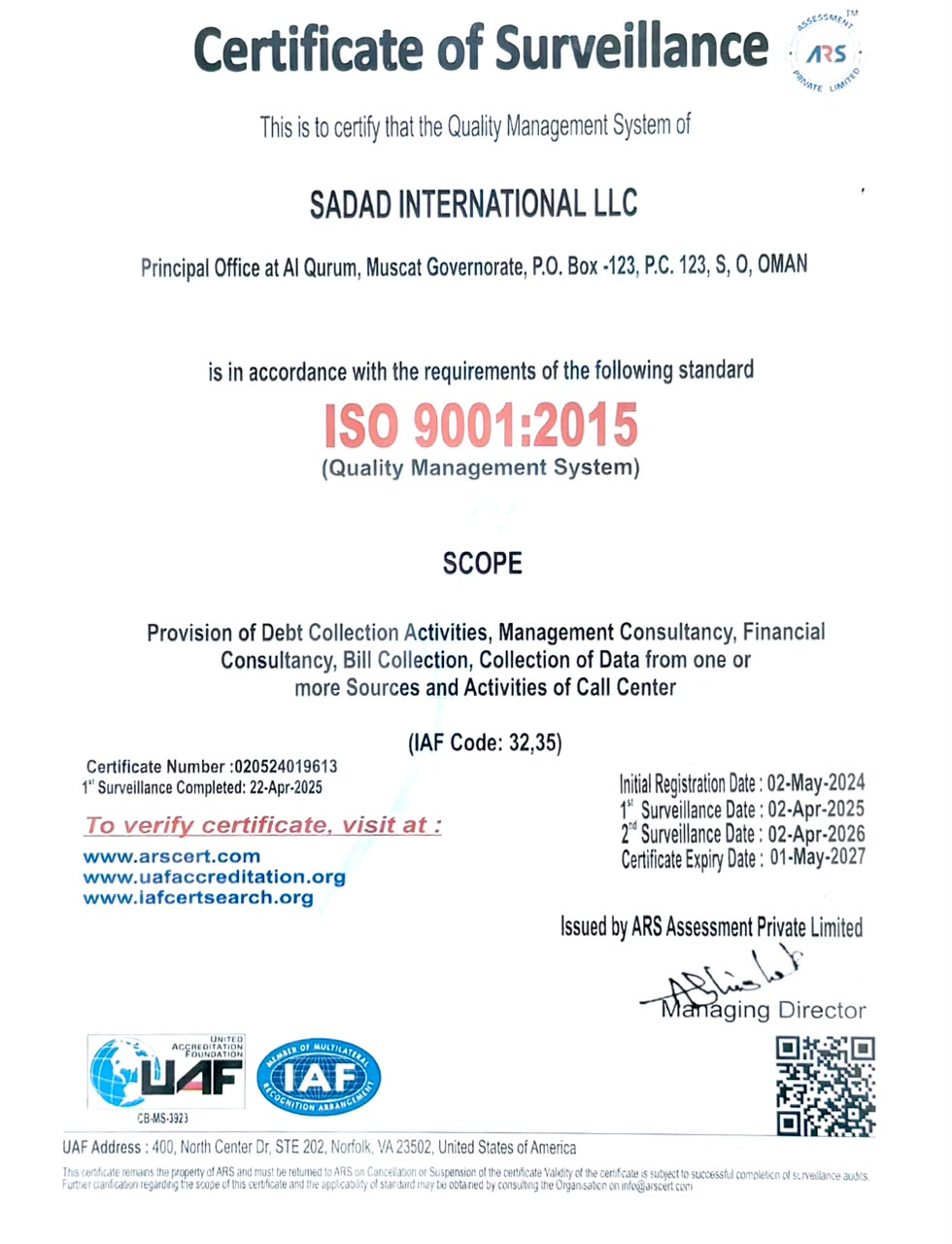
Sadad LLC: credit evaluation for SMEs and receivables management across Saudi Arabia, UAE, and Oman. ISO 9001:2015. Bahwan Group. Contact Sadad LLC directly →
This article is for general informational purposes only and does not constitute legal or financial advice.
.avif)
Comments
No comments yet. Be the first to comment.
Leave a Comment