

How can Omani businesses reduce DSO and improve cash flow?
Reducing DSO in Oman requires five actions: credit evaluation using Mala'a data before extending trade credit; compliant electronic invoicing issued immediately upon delivery; a structured payment reminder programme with escalation at 15, 30, and 60 days overdue; early handover to professional debt collection at 60 days; and regular portfolio review to identify at-risk accounts before they age. Businesses applying all five consistently achieve DSO reductions of 15–30 days within the first quarter of professional receivables management.
Key Takeaways
- DSO measures the average number of days between invoicing and collection, the most important receivables health metric.
- A healthy DSO for most Omani businesses is below 45 days. Above 60 days requires professional intervention.
- Credit evaluation using Mala'a data prevents high-risk trade credit that drives DSO up from day one.
- Electronic invoicing issued immediately upon delivery shortens the payment cycle structurally.
- A structured follow-up programme with reminders at defined intervals is the most effective single DSO reduction tool.
- Professional receivables management companies consistently reduce DSO by 15–30 days within 90 days.
Who This Guide Is For?
This guide is for CFOs, finance managers, and credit controllers in Oman, particularly in construction, real estate, healthcare, logistics, and professional services, who want to reduce their DSO, improve working capital, and build a receivables management process that consistently collects on time.
What Is Days Sales Outstanding (DSO) in Oman?
DSO is the average number of days a business takes to collect payment after a sale. It is the single most important operational metric for cash flow health.
DSO = (Accounts Receivable ÷ Total Revenue) × Number of Days in the Period
Example: A business with OMR 500,000 in accounts receivable and OMR 3,000,000 in annual revenue has a DSO of (500,000 ÷ 3,000,000) × 365 = 61 days. For a business with 30-day payment terms, a 61-day DSO means customers are paying more than a month late, a significant working capital drain. Mala'a credit bureau data (established under Royal Decree 38/2019, regulated by the Central Bank of Oman) is the key tool for preventing overdue accounts that push DSO up.
What Is a Good DSO for an Omani Business?
| DSO Range | Assessment | Action Required |
| Below 35 days | Excellent | Maintain current processes; review quarterly |
| 35–45 days | Good | Monitor monthly; automate reminders where missing |
| 45–60 days | Moderate concern | Review Mala'a evaluation and follow-up processes immediately |
| 60–90 days | Serious concern | Engage a professional receivables management company |
| Above 90 days | Critical | Immediate professional debt collection + full process review |
Warning Signs: When DSO Requires Immediate Action
- DSO has risen by more than 10 days in a single month, indicating a systemic change in payment behaviour, not a one-off delay.
- A Mala'a monitoring alert shows new Investment and Trade Court enforcement proceedings filed against a customer with a significant open balance.
- A specific sector in your AR ledger (e.g., construction, government-linked entities) shows consistently rising DSO, sector-level payment stress building.
- The 60–90-day and 90+-day age buckets are growing as a percentage of total AR; late-stage accounts are accumulating.
- A customer requests a significant payment term extension without a credible commercial reason; a possible financial distress signal.
Five Actions to Reduce DSO in Oman
- Implement Mala'a-Based Credit Evaluation. DSO starts at the credit decision. Mala'a credit bureau data provides payment history, outstanding obligations, and registered assets the intelligence needed to make better credit decisions before trade credit is extended. Businesses implementing Mala'a-based evaluation in new customer onboarding consistently have lower DSO. Sadad LLC credit evaluation service
- Issue Invoices Immediately Upon Delivery. Every day between delivery and invoicing is a day added to DSO unnecessarily. Issue compliant electronic invoices on the day of delivery, confirmed by the customer's electronic acknowledgment. The payment clock starts immediately, the invoice is harder to dispute, and the legal position is stronger if recovery is ever required.
- Implement a Structured Follow-Up Programme. The most direct DSO reduction lever is a systematic programme that pursues every outstanding invoice at defined intervals:
- 15 days before due: Automated payment reminder email or portal notification.
- Due date: Confirm payment receipt. If unpaid, immediate follow-up call.
- 5 days overdue: Telephone follow-up with accounts payable contact.
- 15 days overdue: Formal written reminder from senior finance contact.
- 30 days overdue: Escalation to senior management at debtor company.
- 60 days overdue: Handover to professional debt collection company.
- Hand Over to Professional Debt Collection at 60 Days. The single most powerful DSO reduction action: set an automatic 60-day handover trigger and enforce it consistently. Professional companies reduce DSO faster than in-house teams because collection is their sole focus. Where amicable collection is exhausted, Sadad LLC's in-house legal team escalates to the Investment and Trade Court (established under Sultani Decree 35/2025) without delay or separate law firm engagement. Sadad LLC debt collection service
- Review the Portfolio Regularly for At-Risk Accounts. Early warning signs: requests for payment term extensions, partial payments, and new contact evasiveness appear before the account becomes formally overdue. A monthly portfolio review using Mala'a monitoring identifies these signals and triggers early intervention that prevents accounts from aging into the 90+ day bracket.
How Does Professional Receivables Management Reduce DSO?
| DSO Driver | Without Professional Management | With Professional Management |
| Credit risk | High-risk customers extended credit without assessment | Mala'a assessment: only creditworthy customers given credit |
| Invoice timing | Batched weekly or monthly | Immediate on delivery; days saved structurally |
| Follow-up | Ad hoc, inconsistent | Structured: every invoice followed up at defined intervals |
| Overdue escalation | Internal: slow, competing priorities | Professional: immediate, consistent, specialist |
| Collection speed | Average 90+ days to resolution | Average 45–60 days to resolution |
Ready to Reduce Your DSO in Oman?
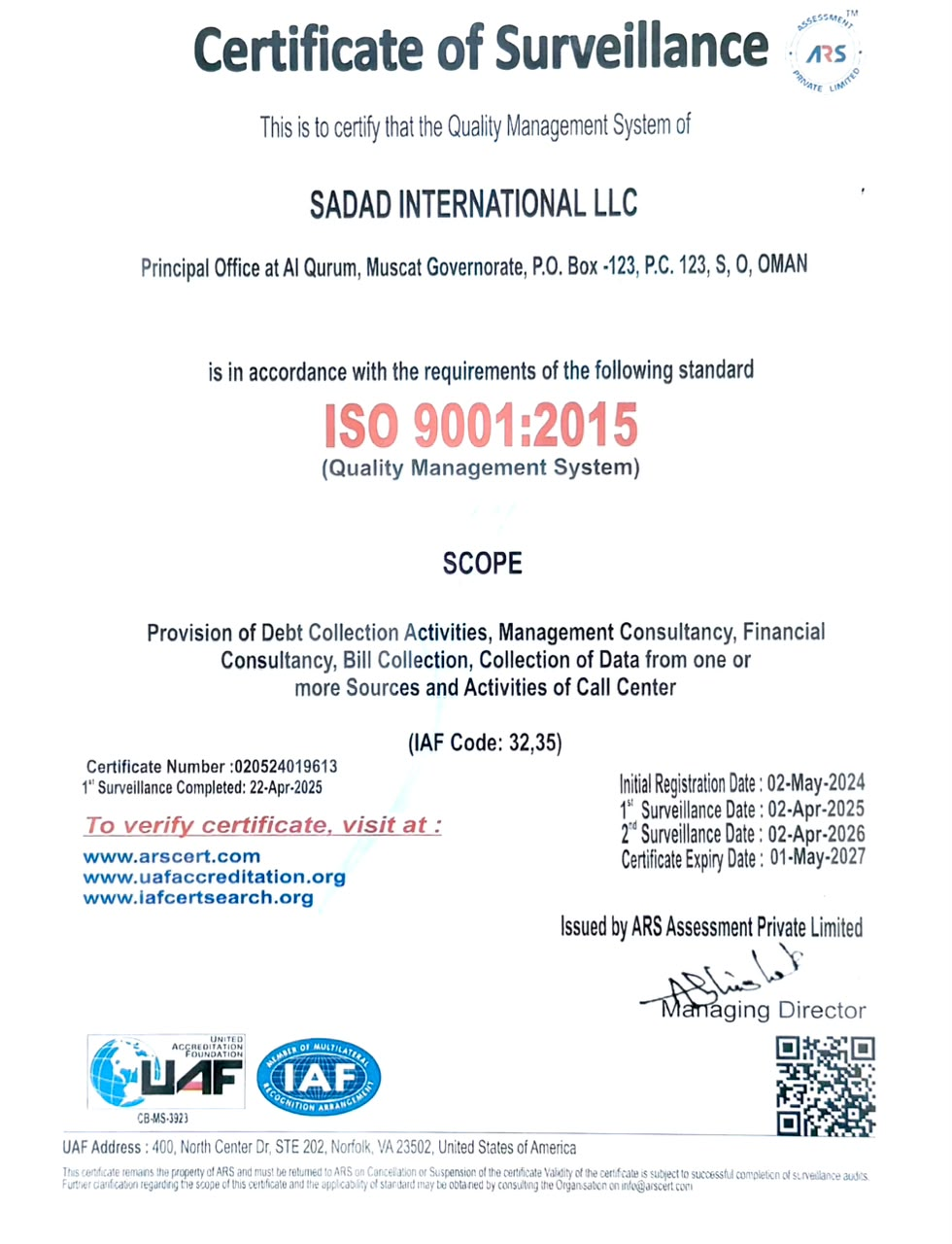
Sadad LLC: receivables management and credit evaluation across Oman, UAE, and Saudi Arabia. ISO 9001:2015. Bahwan Group. Reduce your DSO and improve cash flow today
Disclaimer: This article is intended for general informational purposes only and does not constitute legal or financial advice. Readers should consult a qualified legal or financial professional for advice specific to their circumstances.
.avif)
Comments
No comments yet. Be the first to comment.
Leave a Comment