

What Is the Difference Between Receivables Management, Debt Collection, and Legal Debt Recovery in Oman?
Ask a finance team in Muscat what they need for an overdue account, and "debt collection" is often the first phrase that comes out even when what's actually needed is something else entirely. Understanding the difference between debt collection and receivables management in Oman, and where legal debt recovery fits in, isn't a matter of terminology. Applying the wrong one wastes time, damages a customer relationship that might still be worth saving, or leaves genuine non-payment unaddressed for too long.
Here's the simplest way to think about it: these are three distinct stages of the same journey, each suited to a different point in an invoice's life.
Receivables Management in Oman: The Proactive Stage
Receivables management vs debt collection in Oman comes down to timing first: receivables management is what happens from the moment an invoice is issued through to roughly 60 days while the customer relationship is still active and, in most cases, still healthy. It covers invoice tracking, ageing analysis, structured payment reminders, and early resolution of invoice disputes before they escalate. The tone here is collaborative. Accounts receivable management in Oman, done well, is almost invisible: invoices simply get paid closer to their due date, without friction or damaged relationships.
Debt Collection in Oman: The Reactive Stage
Debt collection begins once an account is genuinely overdue typically past 60 to 90 days and standard follow-up hasn't produced a resolution. This stage involves firmer, structured contact: negotiation, formal demand notices, and settlement discussions. Proactive vs reactive debt recovery captures the shift precisely receivables management works to prevent an overdue account from happening; debt collection works to recover funds from an account that's already overdue.
Legal Debt Recovery in Oman: The Escalation Stage
Legal debt recovery is reserved for cases where amicable collection has genuinely failed, and the amount at stake justifies formal legal action. In Oman, this means proceeding through the court system since October 2025, primarily through the newly established Investment and Trade Court for commercial disputes to obtain and then enforce a judgment. This is when to use legal collections in Oman: not as a first resort, but as the structured next step once direct engagement has run its course.
When to Use Legal Collections in Oman?
A few signals reliably indicate an account has moved beyond amicable debt collection and into legal recovery territory:
1. Repeated broken payment promises across multiple collection cycles
2. A debtor who has become unresponsive to all contact attempts
3. A disputed invoice with no supporting documentation offered by the debtor
4. An amount significant enough that the cost and time of commercial court filing is proportionate to the exposure
5. Signs the debtor may be winding down, relocating, or otherwise becoming harder to pursue over time
Oman's court-based debt recovery system has become considerably more structured and faster since the Investment and Trade Court came into force in October 2025. Filings are electronic, defendants have a defined 15-day window to respond, and enforcement is treated as a dedicated judicial function with its own enforcement judge. This matters practically: legal escalation is no longer the slow, paper-heavy last resort it once was.
Why does the Distinction Matter for DSO Reduction Strategies?
Businesses that treat all three stages as interchangeable tend to make one of two costly mistakes. Some escalate too early, turning a minor, explainable payment delay into an adversarial collections case and damaging a customer relationship that a simple reminder would have resolved. Others escalate too late, letting an account drift for months under "gentle follow-up" while its actual recoverability quietly deteriorates, and by the time legal recovery is finally considered, the debtor has had months to become harder to reach or to dissipate assets.
The businesses that manage this best define, in advance, the point at which an account moves from one stage to the next and apply that timeline consistently. We cover the specific tactics for the first stage in which Omani businesses can reduce DSO and improve cash flow.
Should Receivables and Collections Be Handled by the Same Team?
Increasingly, businesses in Oman are finding that the answer is not by the same people, but by the same accountable partner. Internal sales and account teams are often reluctant to apply firm pressure to customers they'll need to sell to again next quarter, which is exactly where outsourcing to a specialist that runs the full continuum, from receivables management through legal collections, removes the conflict without losing the relationship history.
Sadad Handles All Three Stages, With a Clear Handoff Between Them
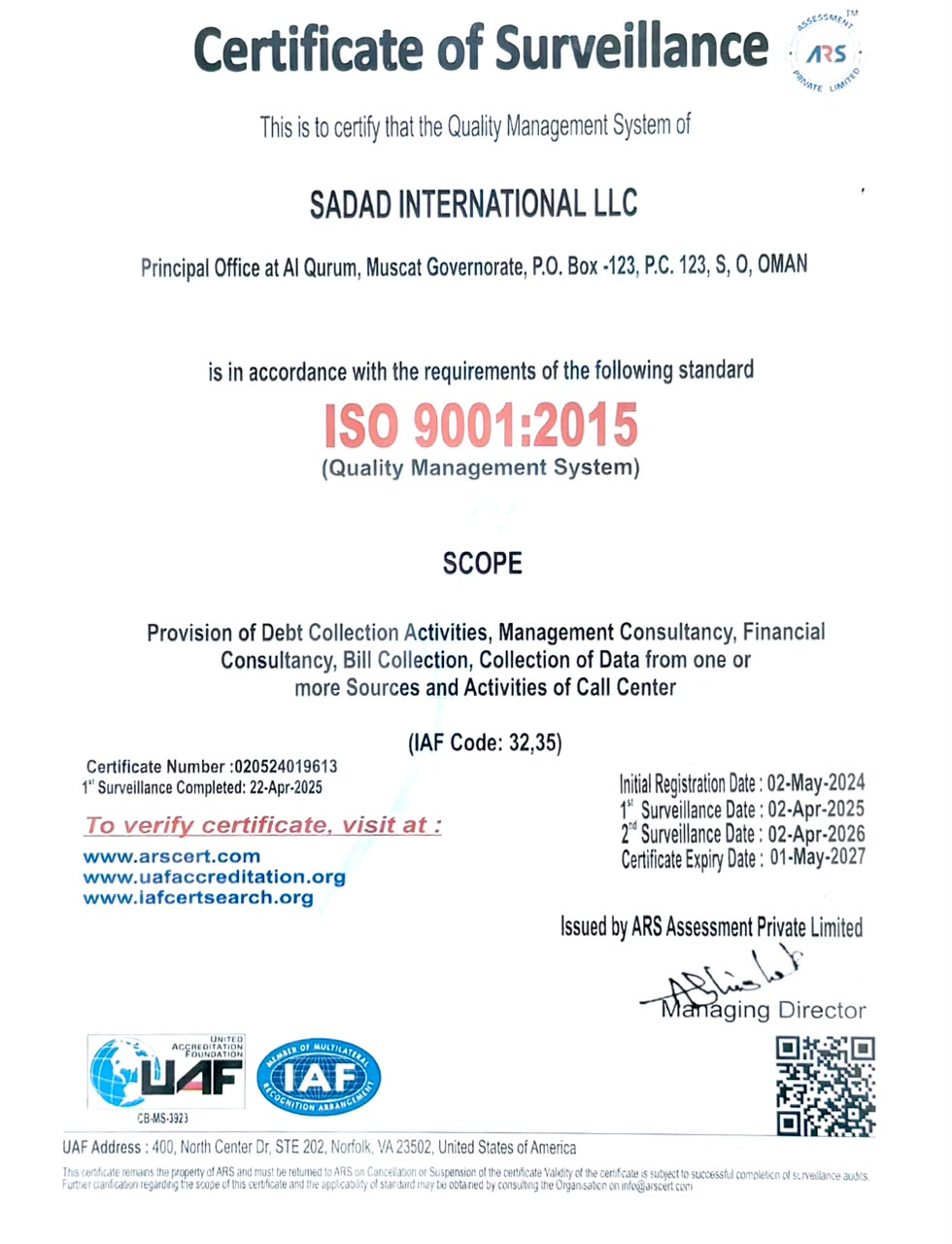
Sadad LLC provides receivables management, debt collections, and legal collections in Oman, so nothing falls into the gap between "still trying to collect nicely" and "already too late." For the broader picture of when to start with credit evaluation rather than either of these, see proactive vs reactive debt management in Oman, or contact our Muscat team to assess where your overdue accounts currently stand.
.avif)
Comments
No comments yet. Be the first to comment.
Leave a Comment