

Accounts receivable outsourcing in Saudi Arabia has moved from a niche option to a mainstream operational decision for a straightforward reason: the demands on the AR function have grown faster than most internal finance teams have been able to scale. Between ZATCA's evolving e-invoicing requirements, rising DSO across several sectors, and simple growth in transaction volume, more Saudi businesses pursuing AR outsourcing in KSA are concluding that receivables management deserves dedicated, specialist attention rather than being one more task squeezed into an already-stretched finance team's week.
The Compliance Backdrop: ZATCA E-Invoicing Is Raising the Bar for Saudi AR Teams
Saudi Arabia's Fatoora e-invoicing programme has been rolling out in phases since Phase 1 became mandatory for all VAT-registered taxpayers in December 2021. Phase 2, the Integration Phase, requiring real-time API connectivity to ZATCA's central platform, has been extending its reach steadily by revenue threshold since January 2023.
ZATCA Wave 24 extends mandatory Phase 2 compliance down to businesses with taxable revenue above SAR 375,000, with a compliance deadline of 30 June 2026. This means a significantly larger share of Saudi SMEs than ever before now need invoicing systems capable of real-time clearance, cryptographic stamping, and structured XML/PDF-A3 formatting. A ZATCA-compliant invoice in Saudi Arabia that isn't properly cleared through Fatoora isn't just a compliance risk; it can delay the entire collection cycle behind it. For businesses newly in scope under Wave 24, this compliance shift is often the exact moment AR processes get re-examined, and AR outsourcing in KSA becomes the most practical way to absorb both the technical and collections workload at once.
Why More KSA Businesses Are Choosing to Outsource Rather Than Build In-House
The Cost of In-House vs. Outsourced AR in Saudi Arabia
Building a genuinely effective in-house receivables function requires more than assigning the task to an existing accounts team member. It requires dedicated headcount, a credit control and collections workflow, reporting infrastructure for ageing and DSO tracking in KSA, and for accounts that go seriously overdue, either in-house collections expertise or a referral relationship with a legal partner. For most Saudi SMEs and mid-sized businesses, the fully-loaded cost of building this in-house exceeds the cost of a specialist outsourced AR partner in Saudi Arabia, especially once the value of faster collection and reduced bad debt is factored in.
Invoice Collection Services That Scale With Transaction Volume
A core advantage of accounts receivable outsourcing in Saudi Arabia is elasticity. Invoice collection services in Saudi Arabia from a specialist partner scale with transaction volume without the business hiring ahead of growth or carrying excess collections capacity during quieter periods. This matters especially for businesses in construction, logistics, and trading sectors with seasonal or project-based revenue cycles that represent a significant share of the Saudi commercial market.
Collection Workflow Automation
Reputable AR partners bring collection workflow automation that Saudi businesses often cannot justify building themselves: automated, timed reminder sequences, ageing-based escalation triggers, and centralised customer payment tracking that KSA finance teams can review without manually compiling spreadsheets. This is frequently the single biggest driver of measurable DSO reduction in Saudi Arabia in the first few billing cycles after outsourcing.
SIMAH Credit Intelligence Before Problems Occur
The most effective AR outsourcing partners in KSA don't just follow up on overdue invoices; they provide SIMAH credit bureau intelligence on new customers before trade credit is extended. A SIMAH credit check reveals payment history, existing debt obligations, and credit risk signals that internal teams rarely have the time or process to review consistently. This moves the AR function from reactive to genuinely proactive, catching high-risk customer relationships before they become overdue accounts.
Debtor Management Without the Relationship Cost
One underrated benefit of debtor management outsourcing in Saudi Arabia: it separates the collections function from the sales relationship. Internal account managers are often reluctant to press hard on overdue payments from customers they also need to sell to next quarter, which is exactly where a specialist collections partner removes the conflict without losing relationship continuity. Your sales team stays focused on the relationship; the collections partner applies appropriate firmness without that constraint.
Benefits of AR Outsourcing for Saudi Businesses Summary
Faster DSO reduction: typically visible within the first few billing cycles after outsourcing begins
Reduced internal staff time: finance teams freed from manual follow-up and spreadsheet assembly
SIMAH credit intelligence: customer risk assessed before terms are extended, not just collected after default
Scalable capacity: flexes with transaction volume without headcount changes
Structured escalation path: direct route into legal collections for the minority of accounts that genuinely need it
Audit-ready AR reporting: ageing reports, DSO tracking, and collection efficiency metrics ready for leadership review
How to Outsource Receivables Management for a KSA Business: 5 Things to Evaluate
- Local Saudi expertise. Confirm the partner operates locally with real understanding of Saudi commercial practice, not a generic regional service applying the same playbook in every market. Knowledge of ZATCA Fatoora compliance, SIMAH credit data, and Saudi Commercial Court processes are the three most important markers of genuine local depth.
- Full-spectrum service coverage. The best AR outsourcing partners in Saudi Arabia offer proactive receivables follow-up through to legal collections under one roof, leaving no gap between "still trying to collect" and "already too late to escalate."
- Transparent reporting. Ageing reports, DSO tracking KSA, and collection efficiency metrics should be standard deliverables, not optional add-ons. If a potential partner cannot describe their reporting suite clearly in the first conversation, that is a signal.
- ZATCA-compliant invoicing integration. Given the current Fatoora e-invoicing rollout and the Wave 24 June 2026 deadline, this is no longer a peripheral question for Saudi businesses. Ask specifically how a potential partner handles ZATCA-compliant invoice processing and what happens if a clearance issue delays collection.
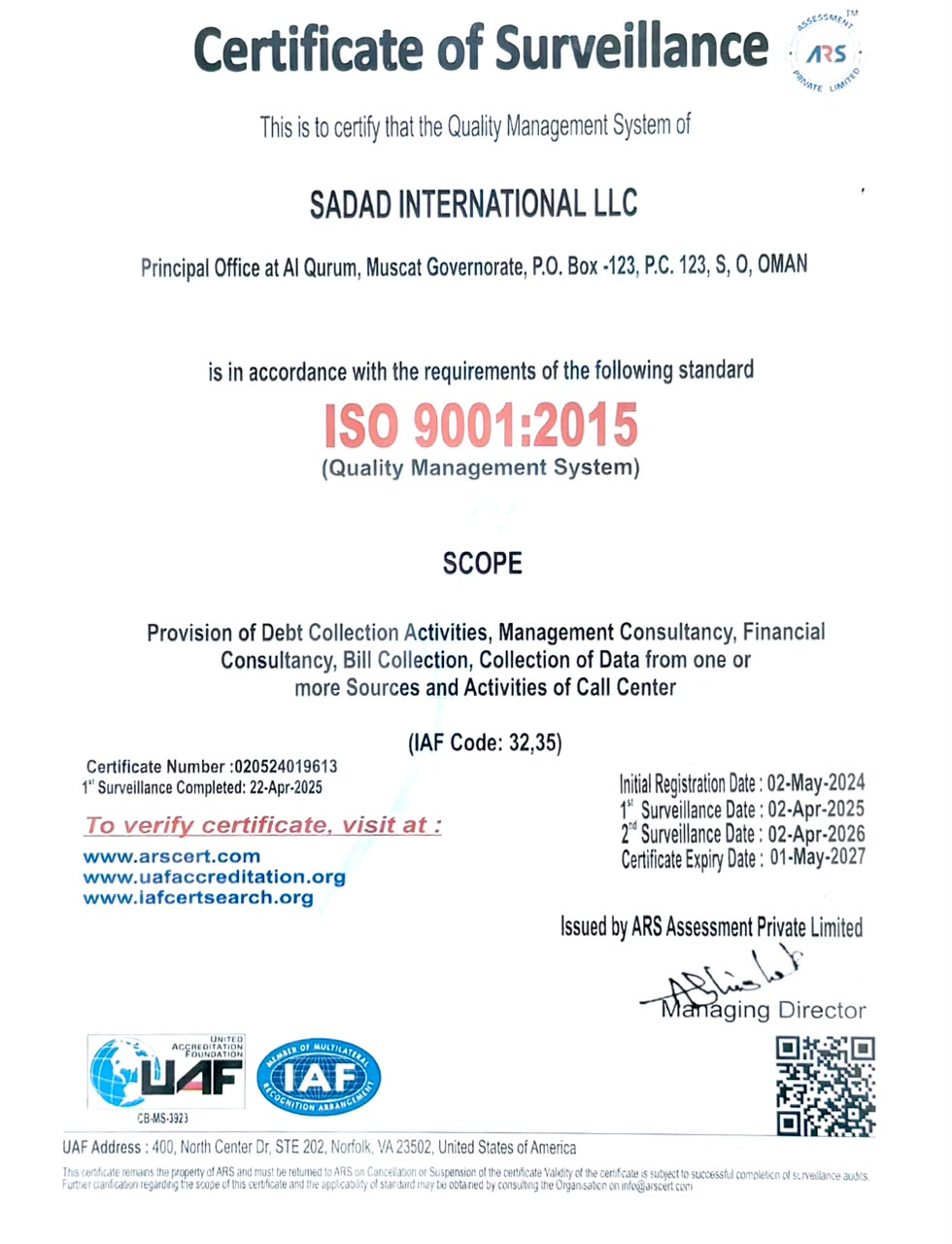
- Track record and certification. ISO 9001:2015 certification, years of Saudi market presence, and transparent client volume are reasonable minimum expectations. Certification signals a structured, audited process, not just a promise of professionalism.
The Cost Comparison: In-House vs. Outsourced AR in Saudi Arabia
Rather than comparing raw fees, the most useful comparison is: what does one avoided or accelerated overdue invoice cover? A single 30-day acceleration of a SAR 50,000 invoice at typical Saudi short-term borrowing rates (roughly 6–7% per annum) represents approximately SAR 750–875 in freed working capital from one invoice, one month faster. For a business with 50 or more invoices in its monthly AR cycle, the cumulative working capital benefit of consistent, faster collection typically outweighs the outsourcing fee many times over, before even counting the internal staff time saved on manual follow-up.
Sadad's AR Outsourcing Service for Saudi Businesses
Sadad LLC provides accounts receivable outsourcing across Saudi Arabia, Riyadh, Jeddah, and Dammam, built around automated tracking, timed reminders, SIMAH-informed credit evaluation, transparent DSO reporting, and a direct escalation path into debt collection for accounts that need it. All processes are ISO 9001:2015-certified and backed by 20+ years of experience in the Saudi and GCC markets under the Bahwan Group. For a broader overview of the difference between receivables management and debt collection, see our guide to receivables management vs. debt collection in Saudi Arabia, our tactical guide on reducing DSO in Saudi Arabia, or contact our Riyadh team to discuss your AR volumes.
This article is provided for general informational purposes and does not constitute financial, tax, or legal advice. For ZATCA e-invoicing compliance specifics, consult a qualified tax advisor or ZATCA's official guidance.
.avif)
Comments
No comments yet. Be the first to comment.
Leave a Comment